Every few months a new AI model arrives and the internet loses its mind for a week. Most of the time you can safely ignore the noise. Kimi K3 is one of the ones worth actually understanding — because it’s genuinely one of the most powerful AI models ever released to the public, it comes from an unexpected place, and anyone can download it. Here’s what it is, why people are talking about it, and whether it matters to you — no jargon required.
So what is Kimi K3?
Kimi K3 is the latest flagship AI model from Moonshot AI, a Chinese startup based in Beijing. It landed in mid-July 2026 and immediately shot up the leaderboards that AI researchers use to rank these systems.
If you’ve used ChatGPT, Claude, or Gemini, you already know the basic idea: you type a question or a task, and the AI writes back. Kimi K3 is in that same family — a large language model — but built at enormous scale and aimed squarely at the models made by the big U.S. labs.
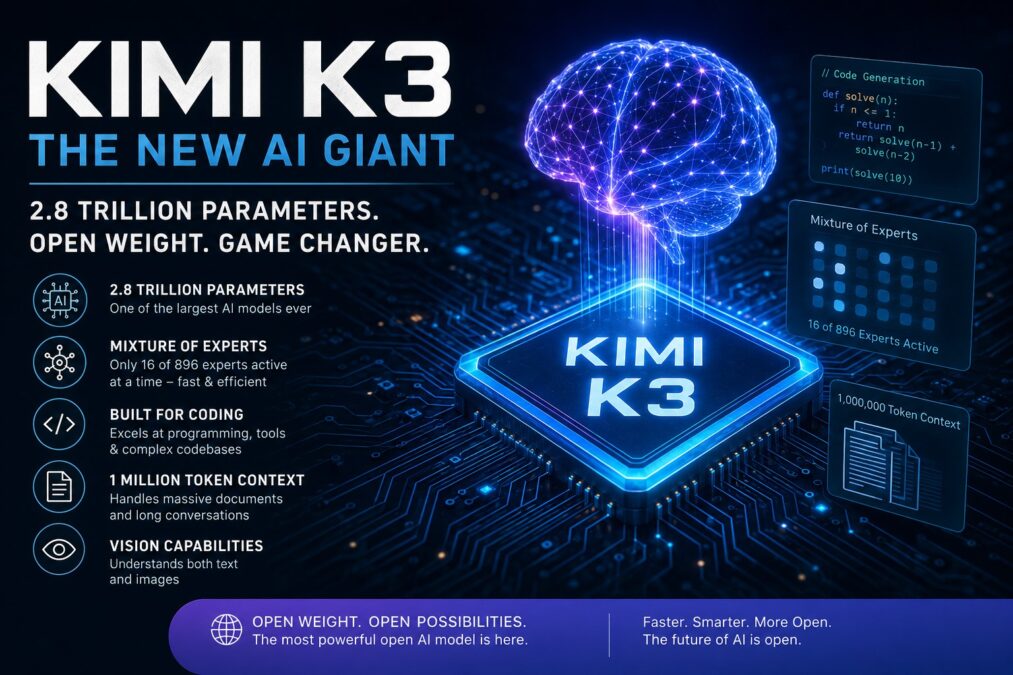
The headline number is its size: 2.8 trillion parameters, which Moonshot describes as the largest openly available AI model to date. “Parameters” are roughly the internal dials a model uses to make sense of language — more of them, done well, generally means a smarter, more capable system.
The part that actually makes it clever
Here’s the neat trick. A 2.8-trillion-parameter model sounds like it would be impossibly slow and expensive to run. But Kimi K3 uses an approach called Mixture of Experts. Instead of firing up the entire giant brain for every single word, it only wakes up the small handful of “experts” relevant to your specific question — about 16 out of 896 of them at a time.
Think of it like a huge hospital: you don’t need every doctor in the building for a sprained wrist. You just need the right specialist. That’s why K3 can be enormous and still reasonably fast.
Why people are impressed
A few things set Kimi K3 apart:
It’s genuinely near the top. On the independent leaderboards that compare AI models, K3 lands in the top three overall. Moonshot itself says it still trails the very best proprietary models — Anthropic’s Claude Fable 5 and OpenAI’s GPT 5.6 Sol — but it beat other strong systems like Claude Opus 4.8 and GPT 5.5 on coding and “agent” tasks. For a smaller Chinese lab to be trading blows with the biggest names in AI is a big deal.
It’s especially strong at coding. Moonshot calls it their most powerful coding model yet, built to handle long programming sessions, work across huge codebases, and use developer tools with little hand-holding. Software developers are the group paying closest attention.
It has a massive memory. K3 has a 1-million-token context window — meaning you can feed it enormous amounts of text (long documents, entire books, big chunks of a codebase) and it can keep track of all of it at once.
It can see. The model has native vision, so it can work with images, not just text.
The word you’ll keep hearing: “open weight”
This is the detail that makes Kimi K3 unusual. Most top-tier models — the ones from OpenAI and Anthropic — are locked up. You can use them through an app or an API, but you can’t peek inside or run them yourself.
Kimi K3 is open weight. Moonshot is releasing the model’s actual “weights” — its trained brain — for people to download, run on their own hardware, and customise. That means researchers, companies, and hobbyists can build on it freely rather than renting access from a single company. It’s the strongest openly available model released so far, and that openness is a large part of why it’s making waves.
What about the cost?
For an AI this capable, K3 is priced to undercut its American rivals. Running it costs around $15 per million words of output — expensive compared to some other Chinese models, but far cheaper than the top U.S. systems, one of which costs roughly $50 for the same amount. For businesses watching their AI bills, that gap is a real draw.
The honest caveats
A few things worth knowing before you get carried away:
It’s not the outright best. By Moonshot’s own admission, the leading proprietary models still edge it out overall. K3 is “frontier-level,” not the undisputed champion.
It’s in high demand. The launch was popular enough that Moonshot temporarily paused new Kimi K3 subscriptions because the surge strained its computing capacity — so access may be patchy in the early days.
Should you care?
If you just want a chatbot to answer everyday questions, you don’t need to switch anything — the AI you already use is fine, and this is more of an industry milestone than a must-have upgrade.
But if you’re a developer, a business looking to cut AI costs, or someone who values being able to run and control your own AI rather than renting it, Kimi K3 is one of the most important releases of the year. It’s a sign that top-tier AI is getting cheaper, more open, and more competitive — which is good news for everyone who uses these tools.
The bottom line
Kimi K3 is a huge, surprisingly efficient, openly available AI model that has vaulted a Chinese startup into the same conversation as the biggest names in the field. It isn’t quite the best model in the world, but it may be the most accessible powerful one — and in a field that usually keeps its best work behind lock and key, that’s what makes it worth knowing about.