
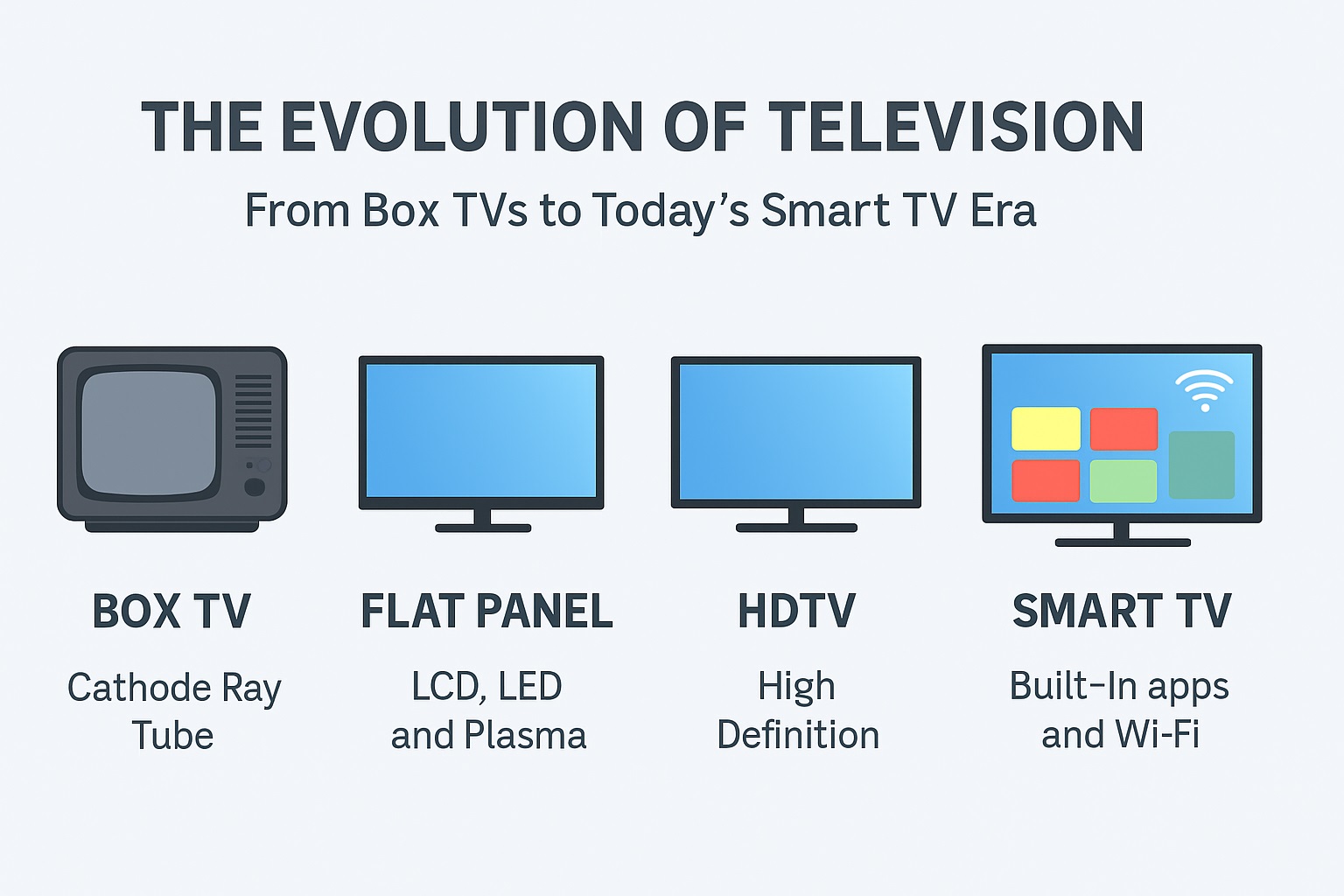
Television has come a long way—from a bulky box sitting in the corner of the living room to an ultra-slim smart device that connects us to the entire world. The journey of TV technology is one of the most fascinating shifts in home entertainment, blending innovation, internet, and interactive experiences.
In this article, we explore how TVs evolved over the decades and transformed into the intelligent Smart TVs we use today.
1. The Beginning: Cathode Ray Tube (CRT) TVs
The earliest TVs were powered by Cathode Ray Tube (CRT) technology. These TVs were:
- Heavy and box-shaped
- Limited to standard definition
- Available in black-and-white first, then color
- Controlled only by manual buttons or basic remotes
Despite limitations, CRT TVs introduced the world to home entertainment and shaped a new era of media consumption.
2. The Shift to Flat Screens: LCD & Plasma
By the late 1990s and early 2000s, TV design took a huge leap forward with LCD (Liquid Crystal Display) and Plasma technology.
Key improvements:
- Slim and lightweight
- Better picture quality
- Larger screen sizes became affordable
- Energy-efficient compared to CRT
This era marked the beginning of modern TV design—sleek, stylish, and wall-mountable.
3. High-Definition (HD) Changes Everything
When HDTVs arrived, viewers experienced clarity like never before.
Features of the HD generation:
- 720p and 1080p resolutions
- Richer colors and sharp details
- Widescreen 16:9 format
- HDMI ports for gaming consoles and set-top boxes
HD made movies, sports, and gaming look dramatically better and set the stage for streaming.
4. LED, OLED & 4K: The Rise of Cinematic Display Quality
As technology advanced, we saw major improvements:
LED TVs
- Brighter screens
- Better contrast
- Energy-efficient
OLED TVs
- True blacks
- Vibrant colors
- Ultra-thin panels
- Superior viewing angles
4K & 8K Resolution
- Four to sixteen times more detail than HD
- A true cinematic viewing experience
- Becoming standard in households around the world
This generation focused on creating immersive and lifelike visuals.
5. The Smart TV Revolution
The biggest transformation came with Smart TVs—televisions that connect to the internet and act almost like large smartphones.
What Smart TVs introduced:
- Netflix, YouTube, Prime Video, and other streaming apps
- Built-in WiFi and Bluetooth
- Voice assistants like Google Assistant, Alexa, and Siri
- Casting from mobile phones
- Gaming, fitness apps, learning apps, and more
- Regular software updates
- Smart home integration
Smart TVs turned televisions into interactive entertainment hubs.
6. Today’s Smart TVs: AI-Powered Viewing
Modern Smart TVs are going beyond streaming.
Next-generation features include:
- AI upscaling to convert older content into near-4K/8K quality
- Adaptive sound based on room acoustics
- Voice and gesture control
- Smart home dashboards for lights, AC, CCTV, etc.
- Cloud gaming without consoles
- Personalized recommendations based on viewing habits
TVs have become central to digital lifestyle and home automation.
7. What the Future Holds
The evolution is still ongoing. Future Smart TVs may include:
- Fully foldable and rollable screens
- Complete smart-home command centers
- Holographic displays
- Better VR/AR integration
- AI co-watching and learning features
Television is no longer just a screen—it’s becoming a connected smart device that merges entertainment, internet, and home technology.
Final Thoughts
The journey from CRT box TVs to AI-powered Smart TVs shows how entertainment and technology have grown together. Each generation made TV more immersive, convenient, and interactive.
As Smart TVs continue to improve, we can expect even more personalized, intelligent, and futuristic viewing experiences in the years to come.